
At St Francis de Sales, we are committed to providing our students with an engaging, evidence based approach to learning and teaching in English.
At our school we have high expectations for our students to demonstrate competency and achieve success in all areas of the English curriculum. Our students develop their knowledge, understanding and skills across the strands of Language, Literature and Literacy in order to become confident readers, writers, speakers and listeners.
The learning and teaching approach adopted is consistent across the school and is underpinned by the MACS Vision for Instruction, the Victorian Curriculum English V2 and is supported by our school’s Instructional Framework.
Core English Components:
Reading
Our reading program focuses on the enjoyment of reading in order to develop a love of books. Our program is founded on the 5 pillars of Literacy which make up the key core areas of teaching and Learning in Reading.
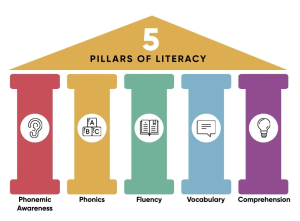
Phonemic Awareness and Phonics:
recognising the sounds in words and understanding letter-sound relationships to decode words.
Partner Reading/Independent Reading:
This provides students with an opportunity to practice their decoding skills, develop fluency, expression and build their vocabulary.
Fluent readers can read accurately, quickly and expressively. Fluency and vocabulary is essential for understanding texts.
Comprehension:
Building word knowledge to support understanding and making meaning from texts.
Comprehension relies on strong decoding skills and fluency, but also on the general background knowledge students have about the various subjects they are reading about.
Central to this is the overarching area of Oral Language which is key to the effectiveness of any English Program. Speaking and listening refers to informal and formal ways oral language is used to convey and receive meaning. The explicit teaching of speaking and listening skills takes place from F-6 through a variety of different experiences across all key learning areas.
Writing
At St Francis de Sales writing is explicitly taught and valued. Students are given opportunities to communicate and express ideas in writing for different purposes and audiences. Writing instruction is a priority across all learning areas and year levels. Our framework provides additional scaffolding and instruction for all students at their point of need.
We develop essential writing skills by:
- Explicit instruction in handwriting and keyboarding skills.
- Explicit instruction in spelling, grammar and punctuation
- Explicit instruction in planning, drafting, composing, evaluating and revision of writing.
- Explicit feedback to progress students.
We build knowledge for writing by:
- Explicitly teaching genre through modelling, guided practice and exemplars and providing subject-specific instruction as required.
- Building knowledge that includes rich content knowledge and language for expressing and developing ideas,.